
.jpg)
Trump-Xi Summit in Beijing: A Defining Moment for a Fragmented World
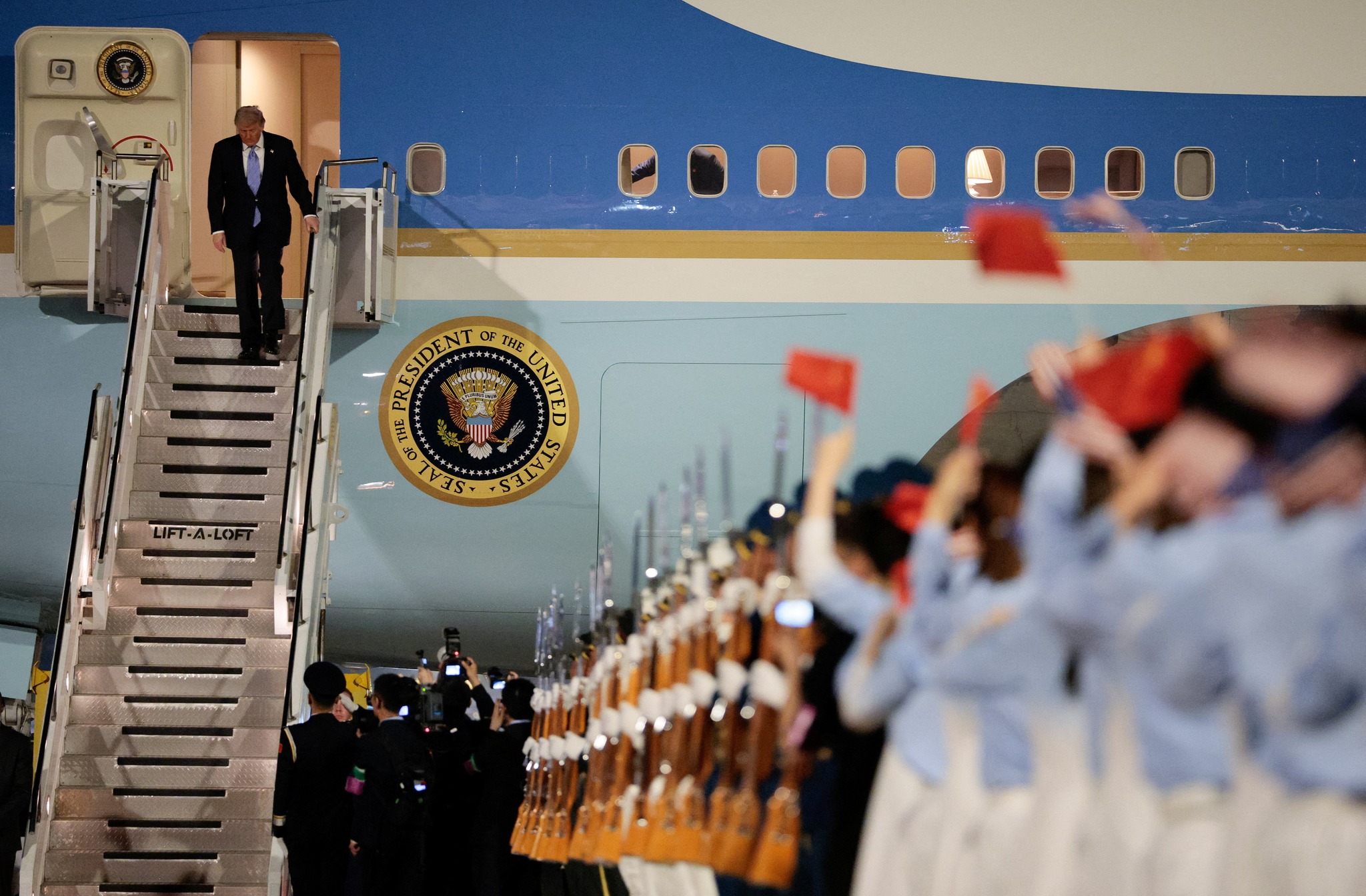
As United States President Donald Trump arrives in Beijing for high-stakes talks with Chinese President Xi Jinping, the world watches with cautious anticipation. Accompanied by leading American technology executives, including Elon Musk, this summit is not merely a diplomatic meeting it is a geopolitical crossroads that may shape the next decade of global economics, technology, and security.
At the heart of the summit lies the growing rivalry between the world’s two largest economies. Trade tensions between Washington and Beijing have evolved far beyond tariffs and deficits. Today, the conflict extends into semiconductors, artificial intelligence, electric vehicles, critical minerals, and the control of strategic supply chains. The phrase “weaponised supply chains” has become a defining reality of modern geopolitics, reflecting how nations now use economic dependence as leverage in global power struggles.
The presence of Silicon Valley and corporate leaders at the summit sends a clear signal: technology is now inseparable from diplomacy. American companies continue to depend heavily on Chinese manufacturing and consumer markets, while China remains determined to reduce its reliance on Western technology. This uneasy interdependence creates both cooperation and confrontation. For business leaders, stability is essential. For political leaders, dominance is the objective.
Another unavoidable issue on the agenda is Taiwan perhaps the most sensitive flashpoint in US-China relations. Beijing considers Taiwan an inseparable part of China, while Washington maintains strategic ties with Taipei under its long-standing “One China” policy framework. Any escalation in the Taiwan Strait would have catastrophic implications not only for Asia but for the global economy, especially the semiconductor industry upon which modern technology depends.
President Trump’s return to direct engagement with China also reflects a broader shift in American foreign policy. While previous years saw increasing rhetoric about decoupling from China, economic realities have made complete separation nearly impossible. American corporations, investors, and technology giants understand that despite political friction, China remains too significant to ignore.
For China, the summit offers an opportunity to project confidence amid slowing economic growth and rising international scrutiny. President Xi seeks to position China as both a stable global power and an indispensable economic partner. Yet Beijing also faces pressure over issues ranging from market access to intellectual property protections and military assertiveness in the Indo-Pacific region.
The participation of Elon Musk is particularly symbolic. Tesla’s massive investments in China represent the deep commercial links between the two nations, even during periods of political hostility. Musk’s presence underscores a modern reality: billion-dollar corporations increasingly operate as unofficial diplomatic actors, shaping international relations alongside governments.
For countries like India, the outcome of this summit carries enormous significance. India stands at the intersection of shifting global supply chains, strategic alliances, and technological competition. As multinational companies seek alternatives to overdependence on China, India has an opportunity to emerge as a manufacturing and innovation hub. However, India must also navigate carefully, maintaining strategic autonomy while strengthening economic resilience.
Ultimately, the Beijing summit is not simply about trade agreements or political optics. It is about the future structure of global power. Will the United States and China find a framework for coexistence, or will the world drift further into economic fragmentation and strategic confrontation
The answer may determine not only the future of international diplomacy but also the stability of the global economy itself.
Advertisement


💬 Comments
No comments yet. Be the first to comment!