
.jpg)
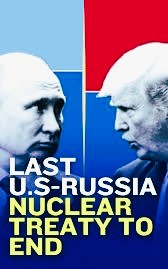
NEW DAY, NEW DANGERS: THE WORLD AFTER NEW START
Here’s the truth. On February 5, 2026, the last remaining nuclear arms control treaty between the United States and Russia quietly expired. No sirens. No emergency summit. Just a deadline passing. With it went New START, the final legal framework that capped and monitored the world’s two largest nuclear arsenals. For the first time in decades, there are no binding limits between Washington and Moscow.
But that’s not the full story. This collapse did not arrive overnight. The treaty had been on life support for years, weakened by political distrust, frozen inspections, and open hostility following the Ukraine war. Long before its formal expiration, New START had stopped functioning in spirit. February 5 merely made the breakdown official.
Why does this matter? Because treaties like New START were never just about numbers. They were about predictability. About knowing how many warheads the other side had, where they were placed, and whether they were increasing. They provided transparency, communication, and time to think. In nuclear strategy, time is everything. When information disappears, suspicion fills the gap.
Now that gap is wide open.
With the treaty gone, both countries are legally free to expand their arsenals, deploy new delivery systems, and test capabilities without inspections or shared data. No violations to report. No inspectors to host. No obligation to explain. The danger is not necessarily that missiles will multiply overnight. The real risk is miscalculation. When rivals guess instead of verify, worst-case thinking becomes policy.
The United Nations has already described this moment as grave, and that assessment is hard to dispute. The end of New START removes the last guardrail of Cold War–era arms control. It also sends a troubling signal to the rest of the world. If the two biggest nuclear powers cannot maintain even minimal restraint, why should anyone else?
This is where the story gets bigger. The expiration of New START does not occur in a vacuum. China is expanding its nuclear arsenal rapidly and has shown little interest in joining arms control frameworks designed for a different era. Europe is rearming amid deep insecurity. New technologies, hypersonic weapons, cyber interference, and artificial intelligence are reshaping deterrence faster than diplomacy can keep up.
And then there is South Asia.
India was never a party to New START, but the global nuclear order still matters deeply to New Delhi. When the great powers abandon restraint, the strategic environment becomes noisier and more unstable for everyone else. Doctrines harden. Modernisation accelerates. Pressure builds to match capability with capability. Stability becomes harder to manage, especially in regions where trust is already thin.
Let’s be clear. This is not an argument for panic. Nuclear weapons are expensive, complex, and politically sensitive. Budgets and logistics impose limits. But history shows that when nations feel strategically cornered, cost becomes a secondary concern. Arms races rarely begin with dramatic announcements. They start with quiet decisions justified as necessary.
So what now?
The blunt answer is diplomacy, but diplomacy with urgency and imagination. The old bilateral model no longer fits a multipolar nuclear world. Any future framework must account for new players, new technologies, and new political realities. That could mean narrower agreements, confidence-building measures, or temporary arrangements that prevent sudden escalation. None of these are easy. All of them are preferable to drifting without rules.
The deeper lesson is political. Arms control survives only when leaders believe it serves their interests. Treaties do not fail because they are flawed on paper. They fail because political will evaporates. When agreements are treated as disposable, the systems that quietly prevent catastrophe begin to erode.
The expiration of New START is not just a technical lapse. It is a warning. A reminder that strategic stability does not maintain itself. It has to be defended, negotiated, and renewed.
The bigger question is this. Will the world treat this moment as inevitable decline, or as a dangerous mistake that still can be corrected?
Because once the rules vanish, rebuilding them becomes far harder. And in a nuclear world, the cost of learning that lesson too late is unthinkable.
Advertisement


💬 Comments
No comments yet. Be the first to comment!