Shenzhen, China | November 19, 2026
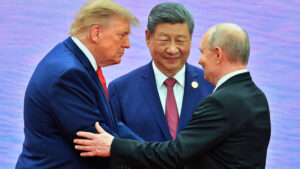
US President Donald Trump, Russian President Vladimir Putin and Chinese President Xi Jinping are reportedly holding an unprecedented trilateral summit in Shenzhen, China, bringing together the leaders of the world’s three largest nuclear powers for high level discussions on global security and strategic competition.
The closed door meeting, taking place alongside the Asia Pacific Economic Cooperation forum, comes at a time of heightened international tensions involving nuclear arms control, the war in Ukraine, the conflict in Iran and competition among major powers.
China’s Foreign Ministry has described the gathering as having groundbreaking significance for strategic stability. However, expectations of immediate formal agreements remain cautious, given the significant differences in the three countries’ strategic priorities.
Nuclear arms control is among the most consequential issues. Following the expiration of the New START treaty between Washington and Moscow in February 2026, the two largest nuclear arsenals are no longer covered by its binding limits. Trump is seeking to initiate discussions on a broader three country arms reduction framework.
China, however, has traditionally resisted joining bilateral US Russia nuclear limits, arguing that its estimated nuclear arsenal remains considerably smaller than those of Washington and Moscow. Analysts suggest that a narrower understanding on restricting the use of artificial intelligence in nuclear command and control could be one possible area of discussion.
The war in Ukraine is another major issue for Moscow. Russian officials have indicated that resolving the conflict is a central priority. Putin may seek to use the meeting to improve Russia’s diplomatic position, limit further sanctions pressure and encourage Washington to influence Kyiv’s negotiating position.
For Ukraine and its European partners, however, any discussions about the country’s future without its direct participation raise serious concerns over sovereignty and territorial integrity.
The conflict involving Iran is also expected to feature prominently. The ongoing US Israeli war against Iran has disrupted energy supplies and increased risks to shipping through the strategically important Strait of Hormuz. Washington and Beijing share an interest in stable global energy markets, although China must also balance its economic relationship with the United States against its strategic ties with Tehran and Moscow.
Trade, energy security and bilateral diplomacy form another important dimension of the discussions. Trump has held separate meetings with Xi and Putin ahead of the trilateral engagement, reflecting the importance of personal diplomacy alongside wider strategic negotiations.
International reactions to the summit remain divided.
Supporters argue that direct communication between the three nuclear powers is valuable at a time when arms control arrangements are weakening and multiple conflicts threaten global stability.
Critics, meanwhile, warn against the possibility of a Yalta 2.0 scenario, in which powerful countries negotiate arrangements affecting smaller nations without their meaningful participation. Ukraine and European security are central to these concerns.
Arms control experts have also cautioned that a single summit cannot deliver lasting disarmament without detailed technical negotiations, verification mechanisms and sustained diplomatic engagement.
The Shenzhen meeting therefore carries significance beyond the immediate discussions. It reflects the growing importance of direct engagement among Washington, Moscow and Beijing at a time when nuclear security, energy markets, regional conflicts and the international balance of power are increasingly interconnected.
Whether the summit produces concrete agreements or simply opens the door to further negotiations, its outcome could influence the direction of global diplomacy in the months ahead.